
Many buildings have fire doors without surviving test certificates or other supporting documents. Two terms you may hear for these doors are notional and nominal. They sound similar, but they describe different situations.
The simplest distinction is this: a notional fire door was considered a fire door when it was installed; a nominal fire door does not meet that definition and is judged on the door and the wider building context.
BS 8214:2026 now addresses both terms. It does not automatically approve either type or say they must be replaced. The decision about whether a door is acceptable belongs within an appropriate fire risk assessment.
What is BS 8214:2026?
BS 8214:2026, Fire-resisting and smoke control doors (Practical considerations concerning specification, design and performance in use) Code of practice, was published by BSI on 20 March 2026. It replaces BS 8214:2016 and is the first edition to explicitly address notional and nominal fire doors.
It is a code of practice, not legislation. It offers recommendations and guidance for fire doors, including their specification, installation and maintenance. Read more in BSI’s information about BS 8214:2026.
What is a notional fire door?
BS 8214:2026 refers to the term notional fire door as defined in the Home Office guide, Fire safety in purpose-built blocks of flats.
In plain English, a notional fire door is an existing door that met the requirements for a fire door when it was installed, but might not meet today’s standards. Its original supporting paperwork may no longer be available, making it difficult to confirm its performance using modern documentation.
For example, an older flat entrance door in a purpose-built block may have been installed as a fire door under the requirements in force at the time. If its original records cannot be found, it might be considered in the fire risk assessment as a notional door. The age of the door alone does not determine whether this label applies.
The term is relevant within a fire safety risk assessment conducted in accordance with the Home Office guidance. It is not a standalone certificate or a general approval of the door.
What is a nominal fire door?
Nominal fire door is an industry term, rather than a formally defined category in BS 8214:2026.
The standard describes doors without documentary fire-resistance test evidence that do not meet the notional definition as sometimes being called nominal fire doors. In other words, there is no documentary evidence to establish that the door met fire-door requirements when it was installed.
A nominal door may never have been designed or intended as a fire door. But the label alone does not tell you what protection it can provide. BS 8214:2026 says it can only be considered to provide a level of fire resistance after an appropriate risk assessment. That assessment needs to consider factors such as the escape arrangements, who uses the building and the building’s full fire safety measures.
Notional and nominal: the difference at a glance
| Notional fire door | Nominal fire door | |
|---|---|---|
| What the term means | An existing door that met fire-door requirements when installed, but might not meet today’s standards. | An industry term for a door with no documentary fire-resistance test evidence that does not meet the notional definition. |
| What is known about its past? | It was considered a fire door under the requirements in force at the time of installation. | There is no documented basis for treating it as a notional door. It may not have originally been intended as a fire door. |
| Where does the term come from? | The Home Office guide on fire safety in purpose-built blocks of flats. | Industry usage; BS 8214:2026 acknowledges the term. |
| How is it judged? | As part of a fire risk assessment conducted in accordance with the relevant Home Office guidance. | Only after an appropriate risk assessment that considers the door and the wider building context. |
| Does the label prove it is acceptable? | No. | No. |
In one line: a notional door has a history of being intended to meet fire-door requirements; a nominal door lacks that basis and is considered on the available information about the door and the building.
What did the 2026 update change?
The update clearly acknowledges that buildings may contain doors without current documentary test evidence, and that not all such doors have the same history. It points readers towards the fire risk assessment for the judgement about their acceptability.
That is an important distinction: BS 8214:2026 does not certify these doors, and it does not declare them automatically compliant or non-compliant. The standard also states that fire risk assessments are outside its scope. It describes the door terms; the assessment considers what is appropriate for the particular premises.
The standard also emphasises that fire resistance belongs to the complete door construction, not to an individual part. The door leaf, frame, seals, hardware and other relevant elements work together. Looking at a door leaf alone, or adding a seal or replacing a piece of hardware without considering the whole assembly, cannot establish the performance of the complete door.
For more context on the wider update, see our BS 8214:2026 explainer.

What does this mean for your building?
Don’t replace a door based on its label alone
Neither notional nor nominal automatically means “failed” or “replace immediately.” The assessment needs to consider the building’s circumstances and the door’s condition. If replacement is recommended, ask for the reasoning to be recorded and connected to the assessment.
Consider the whole building, not just one door
The risk assessment should take account of the means of escape, the building’s occupancy and the full set of fire safety measures. A door cannot be judged in isolation from its role in the building.
Keep clear, per-door inspection records
Where original documentation is missing, accurate records of each door’s construction, condition, photographs and inspection dates can help the responsible assessor understand what is present and what has changed over time. Records also help you track recommended maintenance and follow-up actions.
For practical guidance, read What You Should Get Back After a Fire Door Inspection (and What to Do With It) and our fire door inspection checklist guide.
Use competent support
BS 8214:2026 says inspections should be carried out and recorded regularly, at intervals determined by the risk assessment. It also recommends considering maintenance personnel who operate as a member of a third-party certification scheme. Choose competent professionals who can explain what they have inspected, document their findings and make clear which decisions need to be considered by the fire risk assessor.
Important: BS 8214:2026 is a code of practice, not legislation. Whether a notional or nominal fire door is acceptable is determined through the fire risk assessment for the building. The relevant requirements and guidance can vary by building type and location.
Make every door easier to identify, inspect and manage
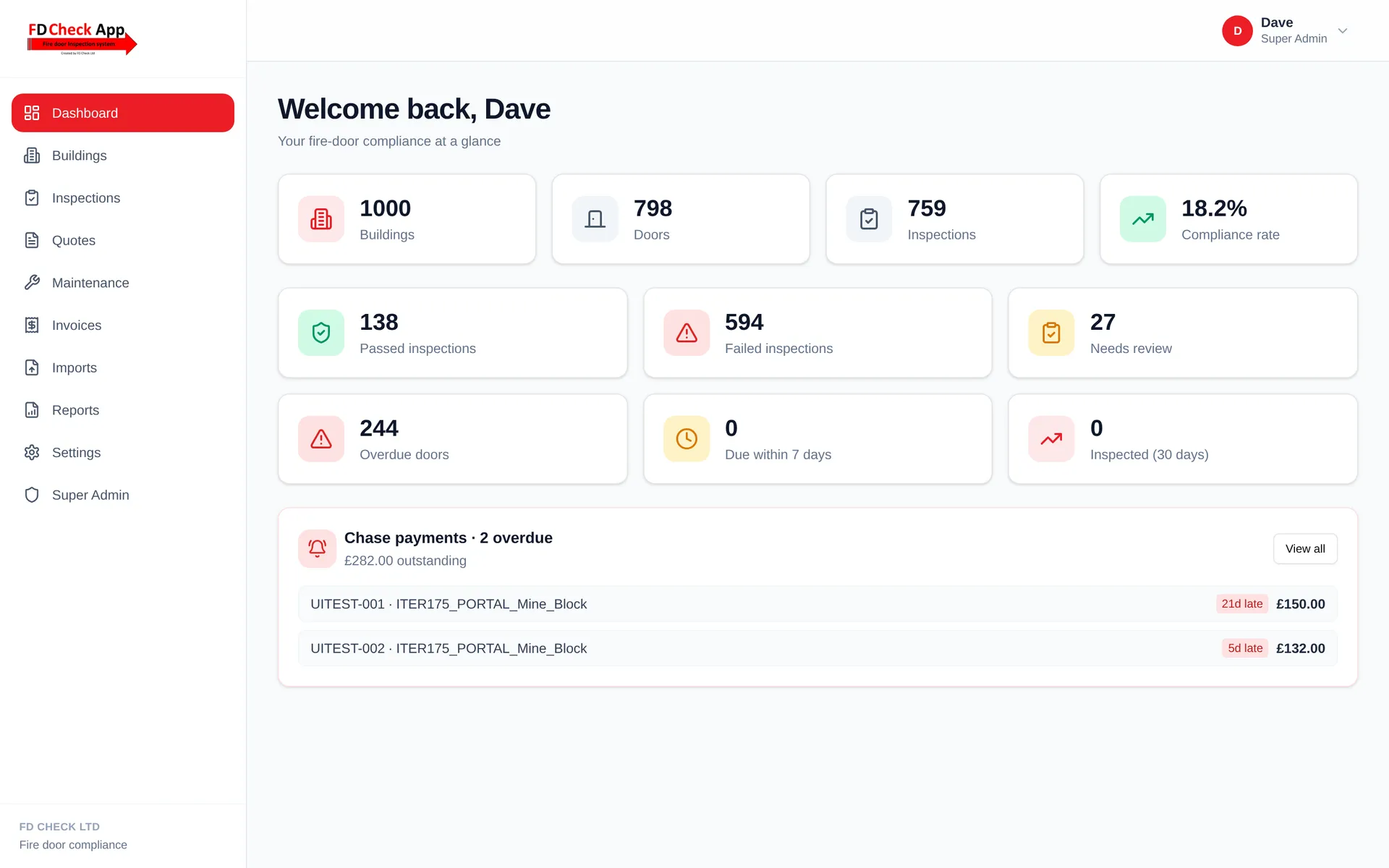
A reliable door register and consistent inspection records give you a clearer picture of your premises. FD Check provides fire door inspections, maintenance and programmed repairs, supported by a digital inspection app developed by fire door inspectors. The app helps build a per-door record with condition details, photographs and remedial actions, making it easier to track findings and share information with the people responsible for the fire risk assessment.
Our qualified inspectors carry out annual and three-monthly checks where applicable. With over 10 years of experience, more than 500,000 completed inspections and over 500 satisfied clients, we provide a comprehensive, cost-effective service without compromising on quality or safety.
If you would like support with inspections, clear records or programmed repairs for your premises, contact FD Check to discuss your needs. We are happy to help you manage your fire door programme with confidence.